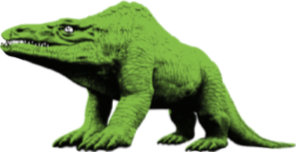

The Friends of Crystal Palace Dinosaurs has embarked upon an exciting new project to restore one of the park’s most important missing sculptures.
The Crystal Palace Dinosaurs, built between 1852 and 1855, were the first effort to reconstruct extinct animals at life-size. They are internationally unique for their vintage and snapshot of early palaeontological interpretation. There are 30+ sculptures in the park but there were many more planned and several we know were made but have been lost.
FCPD undertakes ongoing research to understand the Dinosaurs, and discovered through historical archives that there was a missing sculpture from the Palaeotherium assemblage.
Palaeotherium magnum was a large 2.2 m long, extinct mammal distantly related to horses. It was a highly distinctive and engaging component of the Eocene mammal assemblage in the park but its sculpture apparently went missing in the middle of the twentieth century.
It appears several times in etchings and paintings of Hawkins’ workshop and photos of the original site build in the early 1850s. More recent images of it from 1958 and 1962/63 have now been uncovered through historical archives and a crowd-sourced photo archiving project.

Palaeotherium magnum in several early images: A & B) details from engravings of BWH’s workshop, showing the sculpture just after it was constructed, before being moved on site, 1854; C) a photo of the sculpture in place on the Geological Court (Dinosaur Landscape) during construction, 1854-5

Two of the last known images of Palaeotherium magnum from 1958 (top, left) and 1963 (bottom, centre)
Its whereabouts are entirely unknown, especially as the sculptures have been moved around more than once in the twentieth century, but its absence is now a sad missing element of the park.
The Victorian sculpture of this charmingly dour beast stood very visibly on the water’s edge for over 110 years. It made the palaeothere group much more notable to visitors, whereas now that mammal group is largely hidden, diminished and very overlooked.
It was the largest animal in the assemblage of mammals from the ‘Eocene’ section of the first-ever constructed walk through geological time. Fossils of this extinct animal occur in southern England and other sites in Europe, and date from 48-34 million years ago when the climate was very warm and the vegetation was tropical and subtropical.
Palaeotherium magnum and the other two palaeothere species represented in Crystal Palace were important in the history of palaeontology and went extinct during a period of significant climate change, thus speak to modern concerns. The missing sculpture is an entirely different species from the other sculptures around it, and historically should be in the park according to the original design by Benjamin Waterhouse Hawkins, the artist behind the site.

The current two palaeothere models at Crystal Palace Park, P. medium (on all fours) and Plagiolophus minor (sitting, which is sadly currently missing its head)
We are thrilled that the new sculpture is being built by Britain’s leading palaeoartist, Bob Nicholls, supervised by the Friends of Crystal Palace Dinosaurs and University of Portsmouth staff. Bob Nicholls is known for his recent high-profile designs of British dinosaurs for Royal Mint coins, illustrations for the 2021 book ‘Dinosaurs: New Visions of a Lost World’ by Professor Michael Benton, and many more works in museums, print and film. This project is the first attempt to replace a lost sculpture at the site in 20 years.
The project is the initiative of the charity Friends of Crystal Palace Dinosaurs and is supported by the new Crystal Palace Park Trust and public contributions to the charity. Historic England and London Borough of Bromley have given approval to the initiative. It is being unveiled to the public at Crystal Palace Park on 2nd July 2023.
The P. magnum is one of several current efforts to restore the historically neglected Crystal Palace Dinosaur site. At least eight sculptures have gone missing since the park opened in 1854, mostly under uncertain circumstances. The surviving models and their geological landscape are set to receive urgently-needed conservation in the near future from Historic England and Bromley Council with support from the National Lottery Heritage Fund.

Photo © Jamie Medhurst
The magnificent new sculpture was finally unveiled on the Tertiary island on 2nd July 2023 to a large crowd of Palaeotherium enthusiasts. Poet Joe Duggan read the evocative poem ‘To The Pliocene Skull’ by Francis Bret Harte. Palaeontologist Jerry Hooker and historian Chris Manias spoke about the evolution and history of Palaeotherium magnum.

The images in the video below document the journey of reviving the Palaeotherium magnum sculpture, from designing and building it through to transporting it to site and its final unveiling.
Finally, we have many people to thank for their help and support in this project. We are so very grateful to:
Registered Charity 1165231 (England and Wales)
© Copyright Friends of Crystal Palace Dinosaurs, 2013-2026. Privacy policy.
Hosted on a server powered by 100% renewable energy.
 Follow us on Bluesky
 Like us on Facebook